
Car Diagnostics
When you bring your car in for service or repair, the mechanic will use some kind of diagnostic equipment to see if there are any recorded problems. Modern cars come equipped with computer processors, microchips and sensors which can be hooked up to diagnostic computer scanning software.
Car Diagnostics tools and software help the car mechanic locate problems and identify error messages (such as those that “pop up” on your dashboard) more quickly and more accurately and thus helps reduce repair time. A diagnostic “scan” can identify things like: engine issues, ignition problems, fuel injector performance, engine rpm levels, crankshaft and camshaft position, air and coolant temperatures, etc.
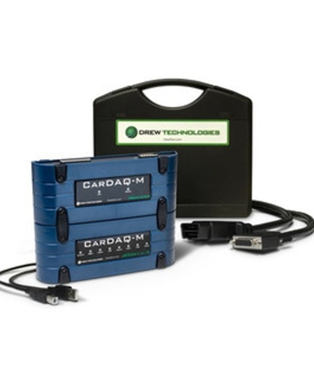
Not to be too technical, we utilize CarDAQ-M® programming by Drew Technologies. This provides us with complete SAE J2534-1 and J2534-2 “pass-through” capabilities for all vehicle makes and models. These devices are the most tested, validated and accepted around the globe by technicians, etc.
E.g., a common problem on many modern cars, is the “Check Engine” warning light that shows up on the dashboard. That fault is often triggered by an intake air leak (a.k.a. “lean condition”) or, by a fuel vapor leak (a.k.a. “evaporative emissions.”)
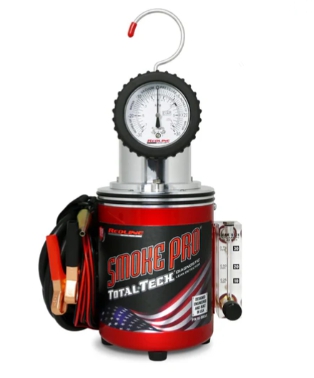
To diagnose and quickly pinpoint EVAP, intake, exhaust, and vacuum leaks, we use professional-grade diagnostic leak detectors like Redline's Detection Smoke Pro which can pinpoint leaks as small as 0.010".